
Ctrl-Alt-History: (Digital) Humanities meets AI
Call for papers
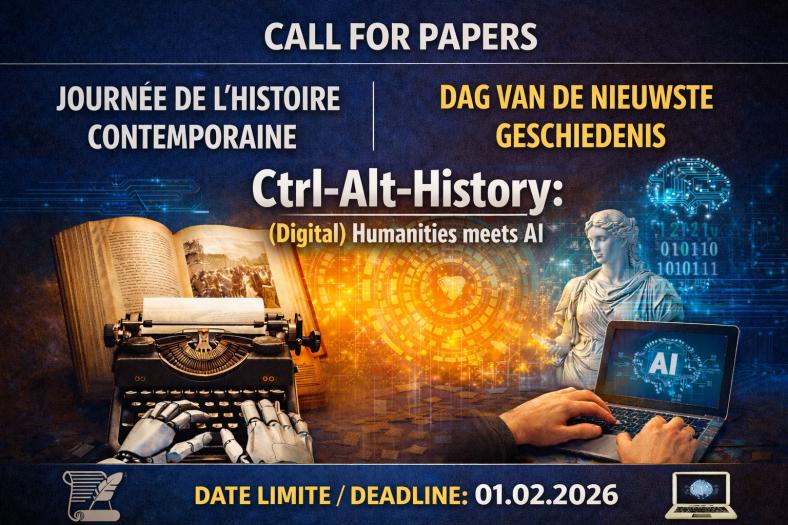
In the last couple of years, Artificial Intelligence (AI) has become a central reference point and even buzzword within (digital) humanities. In almost every research proposal at universities and archives, the AI possibilities and capabilities are (over)emphasized, while those same institutions struggle with its limitations and pitfalls, not in the least with the environmental consequences of its widespread use. AI impacts how research is understood, conducted, valorised, and funded. Its fast-changing abundance of digital tools—from text analysis and image recognition to generative applications—is quickly altering the way historians, archivists, and teachers deal with the past and translate it to the present.
Yet, no substantial debate has taken place on a national level to understand how these processes affect our fields, professions, and society. This 2026 edition of the Dag van de Nieuwste Geschiedenis – Journée de l’Histoire Contemporaine (29.04.2026), organised by the Belgische Vereniging voor Nieuwste Geschiedenis – Association belge d’Histoire contemporaine BVNG-ABHC and the University of Antwerp, aims to focus on the use of AI in (Belgian) historical research, heritage management, and education, and to provide a forum for exploring the opportunities, risks, and challenges of AI within the Belgian historical landscape by inviting contributions that approach these developments critically, empirically, and/or pedagogically.
Call for sessions / papers
We invite contributions that address questions such as (but not limited to):
- Historical case studies and comparisons
- Research that applies digital or even AI techniques to Belgian or comparative historical sources
- Comparative analyses between “classical” and “AI-supported” interpretations and how these models affect research workflows
- Case studies in which digital tools contribute to the (re)discovery of forgotten actors, networks, or perspectives.
- Archives, heritage, and digitalisation
- Application of digital tools in the archive, library, and museum sector: automatic description, image recognition, transcription, or semantic linking of collections.
- Reflections on the collaboration between heritage institutions, universities, and technology teams, e.g. in public history, heritage presentation, and crowdsourcing initiatives.
- Ethical and practical challenges surrounding copyright, privacy, or algorithmic bias in heritage data.
- Education and public history pedagogies
- Integration of digital tools in higher education: opportunities and risks for historical literacy.
- Digital tools in public history and outreach: digital exhibitions, interactive reconstructions, or AI-generated narratives.
- Critical pedagogical approaches to distinguish between source, interpretation, and algorithm
- Audience, reliability, and societal impact
- Methodological, ethical/environmental, and epistemological pitfalls of using AI in historical research (e.g. the impact on theory, methodology, historiography).
- Questions of transparency, reproducibility, and verification with automated interpretation and the redistribution of knowledge authority: who ‘reads’ the past, and who programs the models?
- Critical assessment of biases and distortions when using digital tools, e.g. data selection, algorithmic decisions, or historical inequalities.
Call for workshops
To survey the state of the field and stimulate the exchange of good practices, we also reserve one timeslot for three workshops on the use of digital tools in (historical) research. We invite workshops that dive into the application of digital methods, such as text analysis, image recognition, language learning or machine learning techniques, and apply it to Belgian historical and archival research and teaching. We are specifically looking for sessions that deal with (o.a.):
- How can AI tools help with text analysis, entity recognition, named entity linking, pattern detection (e.g., in newspapers, archives, social media), or data access?
- Can such AI-based workflows be linked to existing digital humanities standards (e.g., TEI, IIIF, Linked Open Data)?
- How can historians, archivists, and educators harness digital tools for producing better, more intelligible histories, grant proposals, and public/educational output?
- How to integrate and evaluate generative tools responsibly into research training and teaching practices?
We particularly encourage hands-on workshops or demonstrations that explore how AI and digital methods can be applied concretely to (Belgian) historical and archival research and teaching practices. These sessions may include tool demonstrations, dataset walk-throughs, or collaborative exercises.
Practical
When? Wednesday, 29 April 2026
Where? University of Antwerp, Stadscampus, Hof van Liere.
Deadline for proposals: 1 February 2026. Acceptance of proposal: End of February 2026. Please send your proposals to info@contemporanea.be.
Proposals may be composed of traditional panels (3 to 4 presentations of 15 minutes) or workshops and other innovative formats (demonstrations, interactive sessions of maximum one hour). You are free to submit a broader panel proposal or an individual paper/workshop. The length of the proposals should be around 300–500 words, clearly stating the research objective, methodology, expected contribution, and central questions. Proposals in Dutch, French, or English are accepted. Early-career researchers and graduate students are particularly encouraged to submit.
Target audience: historians, digital humanities researchers, archivists, heritage professionals, teachers, and anyone working at the intersection of digital technology and history. This Dag van de Nieuwste Geschiedenis – Journée de l’Histoire Contemporaine aims to bring together researchers, heritage professionals, and teachers to reflect on the place of digital tools and AI in contemporary historical practice. By linking concrete examples to methodological and ethical reflections, the study day aims to promote a better understanding of how technology shapes our engagement with the past — in archives, classrooms, and research centres. This day aims to provide a forum for both experimental and reflective contributions on digital methods in the historical field. We hope that participants will inspire each other, share methodological lessons learned, and critically reflect together on the future of history in a context where digital tools are increasingly becoming inevitable.