
POSTWAREX (BRAIN project) (2020-2022)
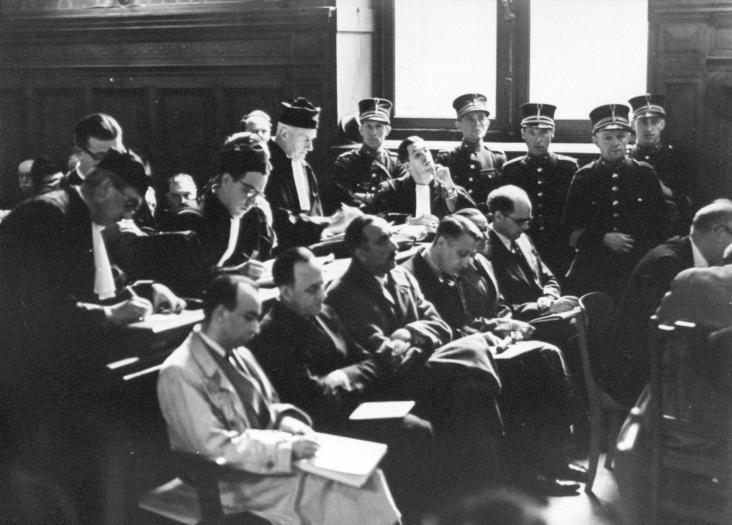
The POSTWAREX research project, which started in 2020 and had a duration of two years, was a collaboration between CegeSoma and the Royal Military Academy (Prof. S. Horvat and Dr. D. Roden) and was coordinated by Dirk Luyten (CegeSoma). The aim was to conduct an in-depth study of the significance of the death penalty as a sentence for acts of collaboration, based on military tribunal archives. For this project, CegeSoma recruited a new scientific collaborator, Elise Rezsöhazy, who obtained her doctor's degree in history at Université catholique de Louvain (UCL) shortly before the start of the project, as well as UCL historian Florence Matteazzi in the final phase of the project.
The project was funded by the BRAIN 2.0 programme (Belgian Research Action through Interdisciplinary Networks) of the Federal Science Policy Office (Belspo); its purpose was to analyse the use of the death penalty after the Second World War by the military justice system as a means of repression against collaboration. This repression was one of the most extensive campaigns of legal action in Belgian history. Its impact on Belgian society lasts to this day.
The repression policy led to the execution of 242 persons who were sentenced to death between 1944 and 1950. It is the most extensive execution operation in the judicial history of Belgium. These 242 executions form an exception in the history of the Belgian judiciary, as no more executions took place after this time.
Archives-based research
The executions led to intense debates in Belgian society. So far, only some aspects of the ‘group of 242’ have been studied based on available sources. The transfer of the military justice archives to the State Archives opened the way for further research in the entire corpus and into new aspects, by associating different types of sources produced by the military courts.
Furthermore, it offered the opportunity to shed new light on the group itself by contextualising the individual profiles of the executed in comparison to the whole group of persons sentenced to death, and by analysing all steps of the decision-making process of the military justice system, from the first criminal investigations until the execution.
The project drew on new research into the death penalty and executions by the military justice during the First World War, which was followed by a long period during which capital punishment was not applied.
The results of the research were published in the book De laatste 242, presented at a conference on 29 November 2023, and used to expand BelgiumWWII with regard to post-war justice.