
Interview with Blandine Landau, an EHRI-ERIC Conny Kristel Fellow at the CegeSoma/State Archives
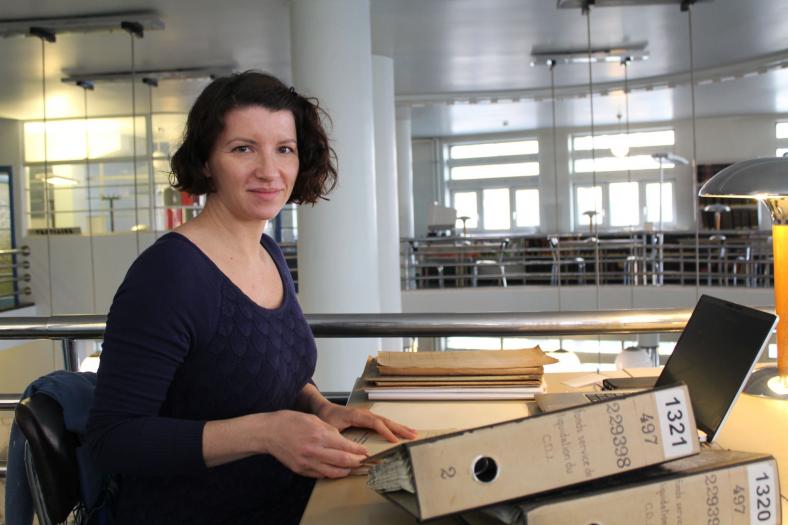
Blandine, you are in Belgium to conduct research for a week as part of EHRI-ERIC’s Conny Kristel Fellowship programme. Can you tell us a bit about your background that led you here?
I first completed an undergraduate degree in art history, museology, and cultural mediation at the École du Louvre, before completing a master’s degree at Paris IV-Sorbonne University, during which I participated in an Erasmus exchange program at KU Leuven. Subsequently, I passed the exam for heritage curators and served as director of the Musée des Émaux et Faïences de Longwy for eight years. In 2015, I reconnected with a professor at Duke University in the United States whom I had met in 2005 during my second master’s degree, which focused on Hieronymus Bosch, and who had suggested that I write a thesis under their supervision. I set out to begin this dissertation on the history of the art market and specifically Bosch’s production. Then, in 2020, I was recruited by the University of Luxembourg to write a dissertation on the dispossession of people classified as Jewish in Luxembourg during the Second World War. If someone had told me ten or twenty years ago, when I was studying at KULeuven, that I would become a heritage curator and then go on to write these dissertations, I wouldn’t have believed them. I then went on to complete a first and now a second postdoc. Currently, I am a postdoctoral researcher at the University of Luxembourg at the Luxembourg Centre for Contemporary and Digital History (C²DH) and am leading a research project focusing on people considered Jewish and who came from Luxembourg and were active in the resistance in Belgium during the Second World War.
What do you hope to achieve with your current research?
My current postdoctoral research focuses on the digital Holocaust memorial project in Luxembourg, led by the Luxembourg Foundation for the Memory of the Holocaust and the University of Luxembourg. The aim of this project is to compile biographies of people who, during the Second World War, were classified as Jewish under Nazi racial laws, without reducing them to their status as victims of the Holocaust. The idea is to explore who they were as individuals, as citizens and as social actors. In this context, the biographies of the people I am researching are primarily intended for this digital memorial. They will subsequently also be used for an exhibition on the role of ‘foreigners’ in the resistance during the Second World War, particularly those considered Jewish, which will take place at the National Museum of Resistance and Human Rights in Esch-sur-Alzette from September 2027 to April or May 2028, followed by a conference in Paris in the spring of 2028. The EHRI-ERIC Conny Kristel Fellowship, of which I am a recipient, is therefore part of this broader research project.
The starting point for this research is a list that was drawn up as part of the work carried out by the Commission spéciale pour l’étude des spoliations des « biens juifs » (Special Commission for the Study of the Spoliation of ‘Jewish Property’) in Luxembourg (2001–2009), a list that was subsequently revised and currently contains the names of just over 5,000 people considered to be Jewish who were residing in Luxembourg before 10 May 1940. I have identified individuals in this file who, during the war, found themselves in Belgium and, among all these people, I am trying to identify those who played an active role in the resistance at one time or another.
Why did you choose this topic?
During my first postdoctoral research project, which was entitled ‘Living Memory’, I collected testimonies from Holocaust survivors with links to Luxembourg. Many people told me about the resistance activities of their fathers, uncles, mothers, and so on. And when I asked them what recognition these deeds had received, in most cases, there had been none. I found this to be an interesting topic to explore, and that is what led me to my current project. The question of the role played by people considered to be Jewish and foreigners (categories that sometimes overlap) in the resistance is one that has attracted relatively little attention in Luxembourg’s historiography, particularly from the perspective of recognition. These are people who have rarely been acknowledged, whether through the award of medals, in historiography, or even in the culture of remembrance (monuments, commemorations).
Did you come across any documents in Belgium this week that stood out for you?
Yes, right here in the archives of the Service for War Victims. There is a file of a Belgian man who lived in Luxembourg and was classified as Jewish under Nazi racial laws. In the autumn of 1940 in Luxembourg, he was subjected to forced labour. He returned to Belgium with his wife and joined the resistance. He then organised the escape of people fleeing to France, either people evading forced labour or Jews. He was caught and first interned at Gurs, then at Pithiviers, where the Belgian Red Cross visited and wrote in a report that they had come across this Belgian citizen: ‘Mr ‘M’ would be very happy if we could help him get out of this camp’. What an understatement!
From Pithiviers, he was then transferred to Drancy and subsequently deported to Auschwitz, after which he was sent through a series of camps, at the end of which he died. The last trace of this person alive outside the concentration camp system is therefore this sentence stating that he “would be very happy if we could help him” … and then his signature registering his arrival at Auschwitz.
Could you explain what a Conny Kristel Fellowship is, how one applies for it, how candidates are selected, and how it is organised in practice?
A fellowship is a research stipend offered by an organisation, a foundation or an institution, the aim of which to support successful candidates for a specific period of time or a project. In my case, I am supported by an EHRI-ERIC fellowship, which offers research stipends, and more specifically the ‘Conny Kristel Fellowship’ programme.
Once a year, a call for applications is published online. Anyone can apply. Applicants are asked to propose a research project related to the Holocaust for which they would like to receive support from the organisation. A number of projects are selected. The duration of this fellowship is between one and six weeks at participating host institutions as in Belgium, the State Archives/CegeSoma and Kazerne Dossin. These fellowships provide researchers with transnational, in-person access to the collections and offer a fixed weekly stipend towards accommodation and subsistence and the reimbursement of reasonable travel costs. The contact person at the host institution plays a key role in facilitating a fellow’s stay (by explaining the administrative procedures for accessing specific files, applying for special permissions where necessary, and booking a place in the archives, etc.). This is invaluable as it ensures that everything runs smoothly on site. The schedule is very detailed and precise.
Research work is a solitary endeavour, but, in reality, it can only be carried out because there are people around to help. People such as Dirk Luyten at the CegeSoma, or others at AGR1, AGR2 or CARCOB, for example, whom I had contacted and who had prepared everything before my arrival. And this is without forgetting the colleague who drew up the lists beforehand that let me know which individuals I needed to track down. It’s really a chain where every link is important. We can only do what we do together and for one another.
Thank you, Blandine, for taking the time out of your busy schedule to discuss your project with us and all the best with your research!