
Belgium’s national node of the European Holocaust Research Infrastructure meets at CegeSoma
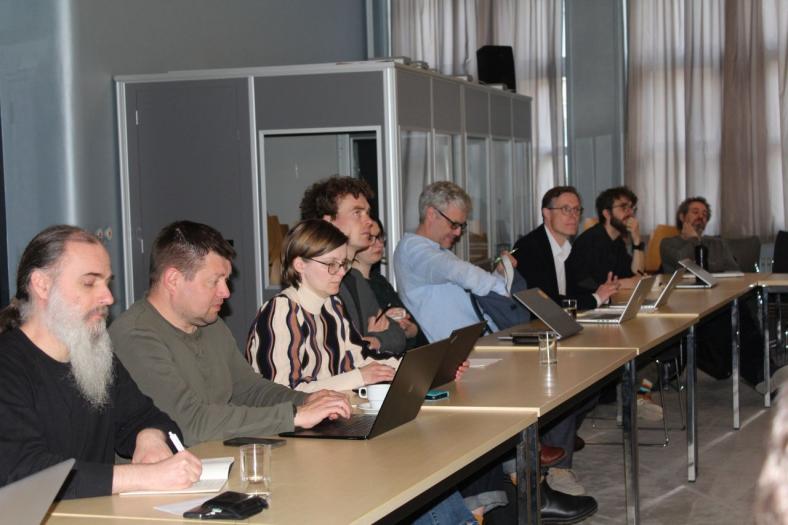
On Monday 20 April 2026, CegeSoma hosted a meeting of the European Holocaust Research Infrastructure’s Belgian node of, EHRI-BE. The meeting was led by EHRI-BE’s coordination team, Dirk Luyten of CegeSoma and Veerle Vanden Daelen of Kazerne Dossin, and in attendance were members from across the EHRI-BE consortium, including historians, archivists and digital humanities experts, as well as representatives of the Belgian Science Policy Office (BELSPO). The aim of this meeting was to bring Belgian partners up to speed on a number of EHRI-related developments that had occurred since the consortium last met, including the launch of a new project: TRACE-BE.
After a warm welcome from CegeSoma’s director, Nico Wouters, Dirk Luyten provided a brief update on EHRI’s establishment as a European Research Infrastructure Consortium (ERIC) at the beginning of 2025 and the governance structure of this organisation. Laurent Ghys of BELSPO then presented an update on Belgium’s membership of this ERIC.
TRACE-BE
With these updates out of the way, it was time to announce the exciting news about the Belgian State Archives (SAB)/CegeSoma’s successful application for research project funding through BELSPO’s ESFRI-FED programme. After Dirk Luyten explained the scope of the ESFRI-FED programme, with its focus on supporting federal scientific institutions in European research infrastructures, the project’s researcher, Matthew Haultain-Gall provided an overview of the project itself. Launched in February, ‘‘Training Research Access and Connectivity for EHRI-BE,’ or TRACE-BE, is a four-year project coordinated by CegeSoma and includes Kazerne Dossin as a funded partner. The project is a natural extension of the work the SAB/CegeSoma has carried out across EHRI’s five European-funded projects to date. Its overarching aims are to consolidate the SAB's position within EHRI by simulating and facilitating archival-based national and transnational research on the Holocaust and contribute to the further development of EHRI-BE.
TRACE-BE will achieve its overarching aims by improving and enriching SAB’s data and data integration; tailoring existing research tools to the needs of EHRI; and by offering transnational access to the SAB’s Holocaust-related collections and training for researchers in Belgium to stimulate Holocaust research. Moreover, mobilising the SAB/CegeSoma’s expertise in EHRI governance will ensure that EHRI-BE reaches a significant level of maturity to fully contribute to EHRI-ERIC, as well as strengthen this federal scientific institution’s position within the Belgian national node, the EHRI-ERIC National Coordinators Committee, and specialised EHRI working groups and regional groupings.
The project’s wide-ranging activities will ensure that Belgian State Archives’ Holocaust-related collections become more easily accessible for researchers and other user communities (educators, experts, museum staff, citizens); encourage more impactful comparative and transnational research using digital humanities methodologies; and enhance the Belgian State Archives’ contribution to EHRI-BE and EHRI-ERIC’s wider objectives.
The needs of the members of EHRI-BE
Once the presentation on TRACE-BE was completed, meeting participants were invited by Veerle Vanden Daelen to discuss what they were currently working on, how it overlapped with EHRI-BE’s work and what support the national node could potentially provide. What followed was a rich discussion on how smaller heritage institutions could benefit from the know-how of larger institutions, the difficulties of aligning databases with different scopes and the standardisation of data, particularly in relation to biographical data.
The meeting then concluded with a succinct overview of the work being conducted in EHRI beyond Belgium. This not only included work organised centrally by EHRI-ERIC, but also that being undertaken by other national nodes as well. Among the activities discussed was the EHRI’s Conny Kristel Fellowship programme, which aims to facilitate international access to a broad range of archives and collections related to the Holocaust, supporting and stimulating Holocaust research and documentation worldwide. The programme is open to researchers, archivists, librarians, curators and other relevant professionals. The timing of this discussion was particularly apposite as just the following day, EHRI announced that its call for 2026 Conny Kristel Fellows was open!
To find out more about the programme, participating partners and the application process, head to EHRI’s website. The call is open until midnight on 7 June 2026.